Showing posts with label 4-Wheel Training. Show all posts

Tuesday, August 29, 2006

Tread Lightly!


Tread Lightly! is a non-profit organization offering educational material, training courses, restoration opportunities, communication pieces and a variety of tools to help arm recreationists with a set of outdoor ethics.

Tread Lightly! offers specific ways to minimize impact when four-wheeling, off-highway motorcycling, mountain biking, geocaching, riding an ATV, hunting with an ATV, snowmobiling, camping, fishing, boating, hunting, horseback riding, backcountry skiing, hiking, sand duning and using a personal watercraft. Click here for some quick tips.

Tread stood for some outdoor ethics as follows:

Travel and recreate with minimum impact
Respect the environment and the rights of others
Educate yourself, plan and prepare before you go
Allow for future use of the outdoors, leave it better than you found it
Discover the rewards of a responsible recreation

In Indonesia, similar efforts are being built by 4-Wheel Adventure Indonesia to pioneer the Friend of Nature program so called the "Sahabat Alam" in Bahasa Indonesia. The effort would initiate a nationwide nature preservation movement related to outdoor lifestyle of people in Indonesia.

Your support in the Sahabat Alam program is appreciated. For info on how to make your support, please visit the web page here.

Thursday, August 24, 2006

4-Wheeling Basics: COPING WITH MUD


By David Lovejoy, extracted from Difflock.

Mud varies so much in so many places, sometimes it is a beneficial surface and at others a blessed nightmare, this is also why no one tyre type can be said to be the best.

Remember, always Stop & Check before you got stuck in the mud! Put on your boots and walk around in the mud. Most small and medium sized four wheel drives exert a similar ground pressure to the human foot (some even less with wider tyres). So if you get stuck walking, what is going to happen to your vehicle?

Look for a route through, gauge the situation and ask questions (people think you are mad anyway so talking to yourself matters little) like "do I need to drive through here, can I go around?" Always remember Tread Lightly - in other words try to make as little impact on the microenvironment as possible. Huge 'rooster tails' of liquid mud, twenty feet in the air, make for good anti-off road public relations and in the long run don't exactly aid to drive train longevity.

When you have no choice but to go through (say, for example its almost closing time or your tea is on the table) pick your route using the following criteria:

  1. Remember mud is like a city, it doesn't just start, it has its slightly soft suburbs and a potentially bottomless center, with varying districts in between.
  2. Stay out of ruts deeper than the height to the bottom of your diff casing to avoid bellying out the vehicle.
  3. Avoid mud or water you don't know the depth of; it's a world of trouble.
  4. Always start off your approach in a suitable gear i.e. one you can change down from if you need to (deep mud saps power like a thick blancmange).
  5. Do not 'floor' the throttle, use gentle amounts of power - too much momentum reduces the amount of control you have over the vehicle and generally you just end up stuck further away from hard ground, thus further from easy recovery by the friend you brought in the last episode.
  6. When you start to lose traction immediately do two things, feather the throttle (lightly) and move the steering wheel slowly side to side from lock to lock.
  7. When you grind to a wheel spinning halt don't just sit there spinning, dip the clutch, select reverse and slowly and gently attempt to reverse out of the situation you are in - remain calm and collected, remember, despite all those people taking photos and laughing, you still have your pride.
  8. When reverse has no motive result STOP, now is the time for recovery - once again remain calm and collected, this makes you appear very cool in front of your public :)

Picture shown is Ruby, courtesy of Jejelogy.Com

Tyre Sizes Explained


By David Lovejoy, as extracted from Difflock Web Magazine.

Many of us often curious about differences in how people measure a tyre size. Some says their tyre size is 31/10.5x15, some says 205x75x15. Also, why there is an increase in gearing when tyre is changed from a 30" diameter to 31" diameter.

Tyre sizes are basically measured by the outside diameter, width and diameter of wheel rim. The measurement itself generally using 3 known universal systems: Imperial, American, and Metric.

Explained:

  • Imperial (7.5x16), meaning a tyre 7.5 inches wide fitted to be fitted on a 16 inches wheel.
  • American (31/10.5x15), meaning 31 inches diameter, 10.5 inches wide to be fitted on a 15 inches wheel
  • Metric (205/75x16), meaning 205 milimeters wide with an aspect ratio (sidewall height) of 75% of the width, to be fitted on a 16 inches wheel.
So, why gearing should be considered when changing tyre sizes? Very basic, it is because you change the rolling circumference of the tyre. Circumference changes as soon as you increase the diameter (or height) of the tyre.

Explained:

Say you are changing your vehicle's 205/75x16 tyre to a 31/10.5x15. The 31/10.5x15 is 10.5 inches wide, whereas the 205/75x16 is a shade over 8 inches wide (205mm). The 31/10.5x15 is approximately 31 inches high. To work out the height of the 205/75x16 follow this sum:

First find out 75% of 205mm (to get the aspect ratio), this is 153.75mm, double this figure (you have two aspect ratios) to get 307.5mm, then divide by 25 (25mm is 1 inch) which will give you 12.3 inches. Add your 16 inches from the wheel diameter to the 12.3 inches of total aspect ratio. This will give you 28.3 inches of total height or diameter.

To get the percentage you have moved up from the original gearing divide the diameter of the new tyre with that of the old. You will find that you have increased the gearing by almost 10%. This isn't a great deal if you have a V8 but it makes a hell of a difference to your average tyred 2.5 diesel engine! To obtain the same power/ torque, you should increase your final gear ratio by at least of that 10% increase in gearing. So if your OEM final gear ratio is 3.5, you should replace it with a 3.85 ratio to obtain the same power like when using the original 205/75x16 tyre.

Have fun trying!

Jeep Launches Safety Edutainment Game


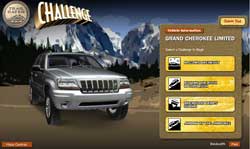
Jeep recently launched the "Go 4x4 Trail Rated Challenge", a new online edutainment game that teaches consumers about on-road and off-road Jeep vehicle safety features and safety driving tips.

The online experience is certainly unique for the automotive industry. Jeep develop this game with the Organic, Inc., an interactive design company in Detroit and New York, USA. The Go 4x4 Challenge presents you with a line-up of different Jeep vehicles and a variety of driving scenarios, within a gaming format, to teach Jeep vehicle owners and in fact all 4x4 enthusiasts about how to manouvre safely through challenging on-road and off-road conditions such as deep water, snow and sand.

If you want to try the game, no matter whether you are a Jeep vehicle owner or not, try it by clicking here.

Wednesday, August 16, 2006

4-Wheeling Basics: ALWAYS ON THE LOOKOUT

You should always lookout to where you are heading. It is strongly advised that you have a co-driver to assist you giving directions on the trail.

Exercise some hand signals with your partner so both would understand each other by just using hand signals. Shouting will not work well in off-road situation due to the engine noise, wind and other noises.

When traveling to new areas that you don't know, find the trail master to give you directions. Even an advanced off-roader would find locals that really knows the area when opening new trails.

So, shift into 4x4 once you start hitting the trail. Shifting to 4x4 when you are already stuck is not a wise thing to do, it will be far more difficult for you to get out of the obstacle. Engage into 4x4 Low Range is strongly advised since in this mode your vehicle is much easier to control and you get more traction whether on dirt, mud or rock.

It is so important that you don't put your thumbs inside the steering wheel, between the spokes. Your wheel might suddenly turned when hitting an obstacle and I can guarantee you will crack the thumbs if they are inside the steering wheel.

Stop n Check! Whenever you are facing an obstacle and you are not sure what is inside and after that, stop the vehicle, engage the parking brake, get out and see the obstacle. Try to figure out how to overcome the obstacle. If you think it is too difficult, might break the car or too dangerous, try to avoid it. Usually your gut will tell the right thing to do. Discuss the obstacle with the rest of the party so everyone knows the recovery plan when things go wrong.

When driving, always scan the course you are taking, sweep your view like a radar scan, from side to side. Don't just put attention on one wheel, say the front right wheel. Remember, when doing this, avoid placing your head outside the car's protective body, you might be hit be a tree trunk or rocks. Always fasten your seatbelts, rollover might happen anytime.

Enjoy the ride the right way and you will experience the real fun. Safe driving!

4-Wheeling Basics: BE PREPARED

I will start posting about 4-wheeling 101 lessons here. I pick the content from my own experience and other sources like Jeep.Com, About.Com, and other sites.

Lesson # 1: Always Make Good Preparation before hitting the trail.

Yes, it is the boyscout first thing to remember. Always be prepared. Make sure your vehicle preparation is well done, from checking the fluids level, fuel, tyre condition, battery, all the way to fastening all bolts and nuts. It is wise to bring spare spark plugs, spare v-belts and other fast moving parts that could turn the fun into a nightmare if trouble happens in the journey.

Aside from preparing the vehicles, of course you don't want to miss the fun in off-roading. So, don't forget to pack some foods and drinks, camera, sunblock, raincoat, tool kits, tents and things you normally bring when going for an outdoor adventure. Travel light, but don't sacrifice the must bring items.

Lesson # 2: Never Go Alone!

No, going 4-wheeling alone is not a smart decision at all. No matter how good are you, dealing with the outback situation would require traveling together with other vehicle. The best is going in a caravan of 3 vehicles. When your car stuck, there are 2 other cars ready for towing.

Assemble your team, do some equipment check with one another to make sure you know what your buddy's vehicle capable of, or the equipment that could be shared, so you can travel light the smart way. Also it is advised to know each other's physical condition for specific illness or allergy, so you won't be shocked when your buddy suddenly fainted maybe because of being bitten by an ant. This happened many times.

I will continue in separate postings.